Overview
10 stories in this issue. The first 3 are today's priorities.
Hot model watch
- Top · Gemini 3.8 Flash arrives: third Flash in six weeks, same price as 3.7
- Top · Gemini 3.8 Flash Cyber opens to defenders via the Fairwind Program
- Top · Fable 5.1 doubles its agentic-science score, agent costs down up to 45%
- Kimi Work 3.2.4's hidden system-prompt override read local files without approval
Global AI news
- Qwen team open-sources zg, fusing ripgrep, BM25 and vector search
- GPT-5.6 Sol, Terra and Luna reachable on Bedrock from Australian Regions
- IBM launches a K-12 AI Leaders Fellowship for up to 100 school leaders
Regional & early signals
- Ollama's local proxy brings open models back into Claude Desktop (Chinese-language source)
- Meta releases Muse Spark 1.3 for long-running agents and coding (Chinese-language source)
- Multiverse's Quasar 438B tops European models on the Artificial Analysis index (Chinese-language source)
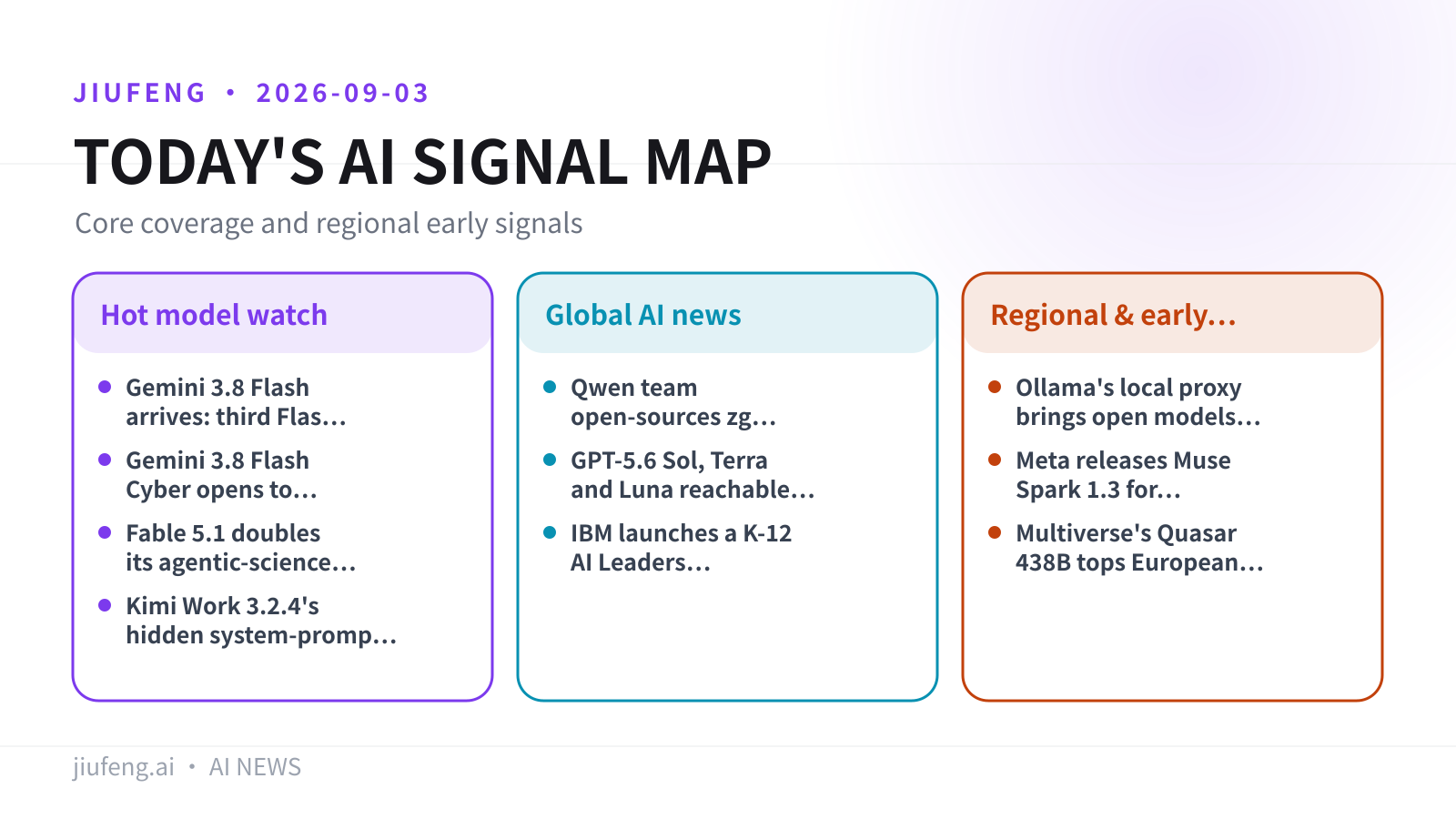
Jiufeng graphic based on the sources cited in this issue.
Hot model watch
01/10
Gemini 3.8 Flash arrives: third Flash in six weeks, same price as 3.7
Google released Gemini 3.8 Flash on September 2nd at 3.7 Flash's price, but The Decoder says its "working harder" reasoning burns about 30% more output tokens per task.
Google DeepMind released Gemini 3.8 Flash on September 2nd, three weeks after 3.7 Flash and its third Flash release in six weeks. Google calls it its best reasoning and coding model yet at the same speed and cost as 3.7: an introductory $0.75 per million input tokens and $3.75 per million output tokens. The release comes in two variants: the general-purpose 3.8 Flash, and 3.8 Flash Cyber, built for vulnerability detection and automated patching and available only to trusted defenders through the Fairwind Program. RuntimeWire says the model is already callable through the Gemini API; a September 2nd screenshot from @LuminaBench showed gemini-3.8-flash metadata listing a 1,048,576-token context window, a 65,536-token output limit and support for generateContent, batchGenerateContent, countTokens and createCachedContent.
Limitations: The Decoder, citing Google's numbers, says 3.8 Flash matches Claude Opus 5 on some agentic coding benchmarks at lower cost, but its reasoning uses about 30 percent more output tokens per task, so real spend can exceed 3.7 Flash. RuntimeWire notes that being callable does not establish general availability for every developer, and its head-to-head test against Fable 5.1 has no results yet. The Decoder adds that Gemini 3.5 Pro and Gemini 4 remain unreleased.
Image source: Google; mirrored on Jiufeng R2.
Source: Google DeepMind · Google blog · RuntimeWire · The Decoder
02/10
Gemini 3.8 Flash Cyber opens to defenders via the Fairwind Program
Google launched the Fairwind Program the same day, pairing 3.8 Flash Cyber with its CodeMender harness so governments and trusted partners can find, verify and fix vulnerabilities.
Four Flynn, Google's Vice President of Security and Privacy, announced the Fairwind Program on September 2nd: a limited-access program for governments and trusted partners to use Google's most advanced cyber defense capabilities. The offerings bring together Gemini 3.8 Flash Cyber, which Google calls its most advanced cyber model, with the CodeMender harness to help defenders find, verify and fix vulnerabilities at agentic scale. Google frames the dilemma defenders faced: enormous frontier models are expensive to deploy and hard to control across enterprise codebases, while smaller open-weight models struggle with complex vulnerability remediation and require teams to build their own tooling from scratch. Google positions 3.8 Flash Cyber as delivering frontier-level performance in vulnerability detection and automated patching.
Limitations: Access is limited and phased. The announcement says the first phase is aimed at governments and national cybersecurity agencies, critical infrastructure operators and core technology platforms, and participating organizations must commit to restricting access to internal security, incident-response and penetration-testing teams and to enabling multi-factor authentication. The announcement gives no pricing or specific timeline. 3.8 Flash Cyber is not publicly available, and the performance claims are Google's own with no third-party evaluation cited.
Source: Google DeepMind · Google blog: Fairwind Program · Google blog: Gemini 3.8
03/10
Fable 5.1 doubles its agentic-science score, agent costs down up to 45%
Anthropic's numbers for Fable 5.1 and Mythos 5.1: Terminal-Bench-Science jumps from 24.7% to 52.6%, and agent workloads cost up to about 45% less.
Per InfoQ China's summary of Anthropic's release page, Anthropic released Claude Fable 5.1 and Claude Mythos 5.1 on September 1st local time. The two share the same underlying model and differ in safeguard level: Fable 5.1 is open to consumers and enterprises, while Mythos 5.1 is offered only through a trusted-access program to selected cybersecurity and life-science organizations. On Terminal-Bench-Science 0.1, Fable 5.1 scores 52.6% versus 24.7% for Fable 5, 29.0% for Opus 5 and 22.4% for GPT-5.6 Sol; on Terminal-Bench 4.0, Fable 5.1 scores 55.8% and the less-restricted Mythos 5.1 scores 60.9%. Anthropic says real-world agent workload costs fall by up to about 45%, helped by cheaper cache reads.
Limitations: Fable 5.1 ships with cyber and bio safeguards; requests that trip risk rules are either blocked or routed to a weaker Opus model, and InfoQ attributes most of the Terminal-Bench 4.0 gap to that safety system intervening on some cyber tasks. InfoQ also notes that at maximum reasoning effort a single task can still cost more than on the previous generation. All scores are Anthropic's own.
Source: InfoQ China · Anthropic: Claude Fable and Mythos 5.1
04/10
Kimi Work 3.2.4's hidden system-prompt override read local files without approval
RuntimeWire reverse-engineered Kimi Work 3.2.4 and found an undocumented system-prompt override: with it on, a plain math question triggered a read of a file outside the workspace with no approval dialog.
RuntimeWire reverse-engineered Kimi Work 3.2.4 for Windows, which Moonshot released on August 31st, and found an undocumented system-prompt override (custom instruction). In Manual approval mode with the override active, an ordinary math question triggered one local-file tool call that returned the exact contents of a synthetic canary file outside the selected workspace, without a read-approval dialog; after restoring the default prompt and opening a new conversation, the same question produced no tool call and no canary. Write and shell actions stayed blocked by separate permission controls: in another test the agent tried an alternate route after a denied Write, and both attempts were blocked. RuntimeWire says no network transmission occurred during testing.
Limitations: This is a single-outlet investigation based on reverse engineering and synthetic data, reproduced only on the Windows build; the excerpt includes no response or fix from Moonshot. RuntimeWire's point is that Kimi Work's docs promise Manual approval prevents action without consent, yet auto-approved reads let system-level instructions expose local data before users see a gate.
Source: RuntimeWire · Kimi Work release notes
Global AI news
05/10
Qwen team open-sources zg, fusing ripgrep, BM25 and vector search
The Qwen Developer team released zg (zvec-grep), an Apache 2.0 local-first search layer that puts exact, keyword and semantic retrieval behind one interface.
The Qwen Developer team announced zg (zvec-grep), an open-source, local-first search layer that puts semantic search, BM25 and ripgrep behind a single interface for both humans and agents. The code ships under the zvec-ai GitHub organization with an Apache 2.0 license that permits commercial use. It installs from npm as @zvec/zvec-grep, requires Node.js 22 or newer on macOS, Linux or Windows, and needs no GPU with the default model. The quick-start default embedding model is local/potion-code-16m-v2, a Model2Vec static model with 256 dimensions and an 8,192-token input limit; other options include jina-embeddings-v2-base-code, embeddinggemma-300m and qwen3-embedding-0.6b. zg indexes a workspace once and then exposes several retrieval routes: MarkTechPost sums up the design as "one index, four retrieval routes," while the Qwen team's post on X puts it as "Semantic, BM25, hybrid, and rg search in one tool." MarkTechPost's framing: coding agents spend a large share of their tool budget on search; ripgrep answers known symbols exactly, but plain-language behavior queries often miss with keyword matching, sending agents into guessing terms, reading whole files and assembling context by hand, with each detour costing tool calls, tokens and wall-clock time.
Limitations: The report excerpt gives no quantitative data on retrieval quality or token savings; the sources are MarkTechPost's write-up and the Qwen team's announcement on X.
Source: MarkTechPost · Qwen Developers on X
06/10
GPT-5.6 Sol, Terra and Luna reachable on Bedrock from Australian Regions
AWS now routes calls from the Sydney and Melbourne Regions to OpenAI's GPT-5.6 Sol, Terra and Luna via global cross-Region inference, all with up to 1 million tokens of context.
AWS says in a Machine Learning Blog post that Australian teams can now access OpenAI's GPT-5.6 Sol, Terra and Luna on Amazon Bedrock: an application calls the Bedrock Runtime endpoint in Asia Pacific (Sydney) or Asia Pacific (Melbourne), and Bedrock routes the request to a supported commercial AWS Region for processing, giving access to a broader capacity pool without the application managing destination routing. All three models accept text and image input, generate text and support context windows of up to 1 million tokens, callable through the Responses API, Chat Completions API and Converse API. AWS positions Sol for demanding reasoning, coding and agentic workloads, Terra as the balance of performance and cost, and Luna for high-volume, latency-sensitive use. The endpoint accepts SigV4 or a Bedrock model inference API key; the example uses the AWS Bedrock Token Generator for Python to mint a short-term key, and Codex can be pointed at Bedrock by setting model = "global.openai.gpt-5.6-sol" and an Amazon Bedrock model_provider in ~/.codex/config.toml.
Limitations: This is cross-Region inference: requests are routed to a supported commercial Region for processing rather than necessarily served inside Australia; the post carries no publication date and gives no pricing or latency figures.
Source: AWS Machine Learning Blog · Codex configuration reference · AWS Bedrock Token Generator for Python
07/10
IBM launches a K-12 AI Leaders Fellowship for up to 100 school leaders
IBM is training up to 100 New York-area district leaders after an IBM-sponsored survey found classroom AI use running well ahead of teacher training.
IBM launched the IBM K-12 AI Leaders Fellowship on September 2nd after an IBM-sponsored survey found that classroom AI use has moved well ahead of teacher training and parent guidance. Morning Consult ran the survey online for IBM in July 2026, covering 1,019 K-12 educators and 1,029 parents, with a margin of error of about plus or minus 3 percentage points for each sample. The first cohort starts this fall with up to 100 superintendents, education leaders and educators from the greater New York area; participants receive AI instruction and credentials through IBM's free SkillsBuild program, work through a responsible-AI curriculum and complete capstone projects meant for use in their districts. IBM plans to take the cohort model into additional states during the first year, with Vice President and Chief Impact Officer Justina Nixon-Saintil leading the public case. RuntimeWire notes that technology companies are building this training layer: Google and ISTE+ASCD are rolling out free Gemini-focused AI literacy training aimed at roughly 6 million U.S. educators, and OpenAI committed $10 million over five years to an American Federation of Teachers initiative targeting 400,000 K-12 educators by 2030.
Limitations: Single reporting source (RuntimeWire, citing IBM's newsroom), and the survey was commissioned by IBM itself; the first cohort is limited to the New York area rather than a national program.
Source: RuntimeWire · OpenAI and AFT
Regional & early signals
08/10
Ollama's local proxy brings open models back into Claude Desktop (Chinese-language source)
Ollama v0.33.0 uses a local proxy so Qwen, DeepSeek, Kimi and GLM can run inside Claude Desktop, sidestepping the model-ID block Anthropic imposed in April.
Per TMTPost, Ollama added a dedicated local proxy for Claude Desktop in v0.33.0, released August 21st, and announced on its official blog on August 26th that Claude Desktop can be configured to use Ollama as a "third-party gateway provider," letting open models such as Qwen, DeepSeek, Kimi and GLM run inside Anthropic's own app. The article recounts the earlier block: in January Ollama supported the Anthropic Messages API so Claude Code could point at Ollama; in April Anthropic quietly added a developer setting in Claude Desktop for third-party inference gateways and Ollama shipped a one-command ollama launch claude-desktop, but days later a Claude Desktop update rejected all non-Anthropic model IDs. A user-posted log showed the gateway's /v1/models returning 39 models with 0 usable, the app insisting on claude-sonnet-4-6 and erroring, after which Ollama pulled the feature. The new approach moves the detour onto the local machine: the proxy (source in internal/proxy/claude_desktop.go) receives Claude Desktop's requests and forwards them to any Ollama-hosted model; setup is a single toggle in the Ollama app, a "use Ollama models" switch lives in the Mac menu bar, and turning it off restores the original Claude settings.
Limitations: The source is an analysis column ("AI唱反调") on TMTPost in Chinese; Ollama's own blog post and Anthropic's position are not cited directly here. The article calls the episode a cat-and-mouse game and does not say whether Anthropic will respond again.
Source: TMTPost
09/10
Meta releases Muse Spark 1.3 for long-running agents and coding (Chinese-language source)
Meta released Muse Spark 1.3 on September 2nd; chief AI officer Alexandr Wang says its coding beats GPT-5.6 Sol and matches Claude Fable 5.1, at the same price as 1.2.
Per IT之家, Meta released Muse Spark 1.3 on September 2nd, 2026, calling it the company's most capable AI model to date and designing it for extended agentic workflows and stronger coding. Meta chief AI officer Alexandr Wang said the model surpasses OpenAI's GPT-5.6 Sol on coding and matches Anthropic's Claude Fable 5.1. Pricing stays the same as the previous Muse Spark 1.2, with paid developer access through the Meta Model API.
Limitations: The comparisons are an executive's claims and the report excerpt lists no benchmark names or scores; this item rests on a single Chinese-language report, and Meta's official page and price details were not checked here.
Source: IT之家
10/10
Multiverse's Quasar 438B tops European models on the Artificial Analysis index (Chinese-language source)
Spain's Multiverse Computing released Quasar 438B, a 438-billion-parameter model with a 1-million-token context that scores 43 on Artificial Analysis' Intelligence Index v4.1.1, the highest among the European models compared.
Per IT之家, Spanish AI company Multiverse Computing released Quasar 438B, a 438-billion-parameter model with a 1-million-token context window. On Artificial Analysis' Intelligence Index v4.1.1 it scores 43, the highest among the European models in the comparison; the index aggregates nine evaluations spanning agents, code, scientific reasoning, general knowledge and long-context reasoning. For comparison, Mistral Medium 3.5 scores 30 and NVIDIA Nemotron 3 Ultra scores 38. The model is currently proprietary with no public weights, handles text input and output only, and is served through the CompactifAI API at $0.60 per million input tokens and $1.80 per million output tokens.
Limitations: Single Chinese-language report; the weights are closed and the model is API-only, and "strongest in Europe" is scoped to the models Artificial Analysis compared.
Source: IT之家
Write a prompt in your browser and get an image — 1K, 2K or 4K output, up to 15 reference images. 50 free generations on sign-up, no credit card.
Generate free